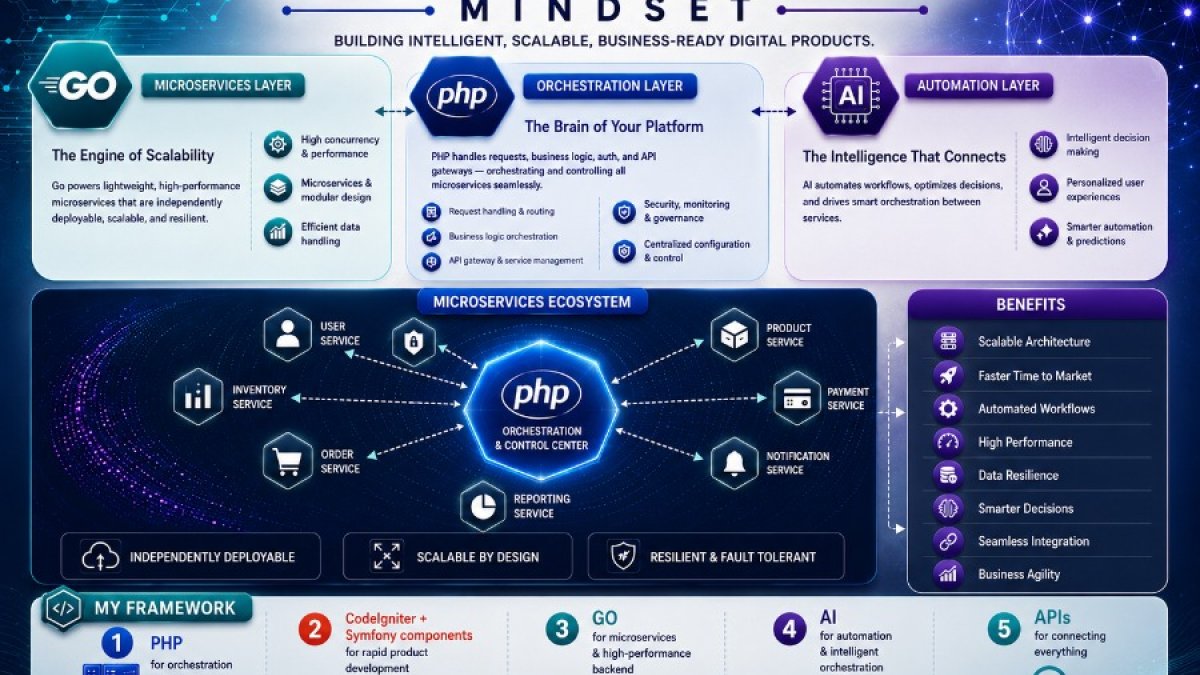
PHP + Go + AI: The Modern Microservices Architecture for Scalable Products
PHP + Go + AI: The Modern Microservices Architecture for Scalable Products
For years, the monolithic application reigned supreme. Building a new product often meant a single, cohesive codebase, typically written in a language like PHP, Java, or Ruby. This approach offered simplicity in development and deployment, especially for startups and smaller teams. However, as user bases grew, feature sets expanded, and the demand for real-time responsiveness intensified, the limitations of the monolith became increasingly apparent. Scaling a monolithic application often meant scaling the entire system, even if only one small part was experiencing heavy load. This led to inefficient resource utilization, longer deployment cycles, and a higher risk of introducing bugs that could bring down the entire application. The landscape of software development has shifted dramatically, and with it, our requirements for scalability, resilience, and agility.
The realization dawned that a single technology stack, no matter how well-chosen, was often no longer sufficient to meet the diverse and demanding needs of modern, scalable products. Different parts of an application have fundamentally different requirements. Some components need rapid iteration and business logic flexibility, while others demand raw performance, low latency, and efficient concurrency. Trying to force all these disparate needs into one technological box inevitably leads to compromises. This is where the concept of microservices architecture truly shines, and where a thoughtful combination of technologies like PHP, Go, and AI can create a potent, future-proof system.
Why PHP Still Matters in a Microservices World
It might seem counterintuitive to champion PHP in an article about modern microservices, given its historical association with monolithic frameworks. However, PHP has evolved significantly, and its strengths are remarkably well-suited for specific roles within a microservices ecosystem. Dismissing PHP entirely would be a grave mistake, akin to discarding a versatile tool from your toolbox simply because newer, shinier tools exist.
The Mature Ecosystem and Rapid Development
PHP boasts one of the most mature and extensive ecosystems in the development world. The sheer volume of libraries, packages (thanks to Composer), and community support means that for many common tasks, you can find a pre-built, well-tested solution. This dramatically accelerates development velocity. For tasks that involve complex business logic, form handling, CRUD operations, and integrating with various third-party services, PHP’s rapid development capabilities are invaluable. When you need to get a new feature or a new service to market quickly, PHP remains a top contender.
Excellent for Business Logic and Orchestration
Let’s be honest: processing complex business rules, managing user sessions, orchestrating workflows, and handling intricate data transformations are areas where PHP truly excels. Languages like Go are powerful, but expressing intricate, multi-step business logic can sometimes feel more verbose and less intuitive than in PHP. Frameworks like Laravel and Symfony have honed the art of making complex application development manageable and enjoyable. They provide robust tools for routing, templating, database interaction, and more, which are perfectly suited for services that act as the glue between other components or manage core business processes.
Frameworks Driving Innovation
The modern PHP landscape is dominated by powerful frameworks. Laravel, with its elegant syntax and comprehensive features, has set a high bar for developer experience. Symfony, known for its flexibility and reusable components, powers a vast number of applications and is itself the foundation for many other PHP projects, including parts of Laravel. Even lighter frameworks like CodeIgniter continue to offer a performant and accessible path for smaller projects or specific microservices. These frameworks provide structure, security, and best practices out-of-the-box, reducing the cognitive load on developers building new services.
PHP as a Superior Orchestration Layer
This is where PHP truly shines in a microservices architecture. Think of the orchestration layer as the conductor of an orchestra. It doesn't necessarily play every instrument, but it directs them, ensures they play together harmoniously, and manages the overall flow of the music. PHP, with its robust frameworks, is exceptionally well-suited for this role. It can efficiently handle incoming requests, delegate tasks to specialized microservices (often written in Go), aggregate their responses, and return a unified result to the client. This is a crucial distinction: PHP isn't always the best choice for raw performance-critical tasks, but it excels at managing complexity and coordinating distributed systems.
Why Go Is the Perfect Microservices Companion
If PHP excels at orchestration and business logic, Go (or Golang) is the undisputed champion for building high-performance, concurrent microservices. Developed at Google, Go was designed from the ground up to address the challenges of modern, large-scale distributed systems. Its features align perfectly with the demands of microservices architecture.
Unmatched Performance Characteristics
Go is a compiled language, meaning its code is translated directly into machine code. This results in significantly faster execution speeds compared to interpreted languages like PHP. For services that need to handle a high volume of requests with minimal latency, Go is the ideal choice. Its performance is often on par with C or C++, but with a much simpler syntax and memory management model.
Built-in Concurrency Model
Concurrency is the backbone of modern scalable systems, and Go’s concurrency model is one of its most compelling features. Goroutines are lightweight, independently executing functions that can run concurrently. They are far more efficient than traditional threads, allowing an application to handle thousands or even millions of concurrent operations with minimal overhead. Go’s `select` statement and channels provide a clean and powerful way to manage communication between goroutines, making it easy to build highly concurrent services that can handle many requests simultaneously.
Low Memory Footprint
Compared to languages with large runtimes or garbage collectors that can consume significant memory, Go is remarkably efficient. Its compiled nature and optimized garbage collector result in a low memory footprint, which translates to lower hosting costs and the ability to pack more services onto a single server. This is particularly important when running a large number of fine-grained microservices.
Easy Deployment
Go compiles into a single static binary with no external dependencies. This makes deployment incredibly straightforward. You simply copy the binary to your server, and it runs. There’s no need for a separate runtime environment like the PHP interpreter, no complex dependency management on the server, and no issues with version conflicts. This simplicity drastically reduces deployment friction and allows for faster, more frequent releases.
Reliability and Simplicity
Go’s syntax is intentionally simple and minimalistic. This leads to code that is easier to read, understand, and maintain. The language enforces certain best practices, reducing the likelihood of common errors. Its strong static typing helps catch errors at compile time rather than during runtime. This focus on simplicity and reliability makes Go an excellent choice for building robust microservices that can operate autonomously and reliably.
Real-World Service Examples Benefiting from Go
Think about services that require high throughput and low latency:
- API Gateways: While PHP can handle orchestration, a Go-based API gateway can efficiently route and transform requests, especially under heavy load.
- Real-time Communication Services: WebSockets, chat applications, and live data feeds benefit immensely from Go’s concurrency.
- Background Job Processors: For computationally intensive or I/O-bound tasks that need to be processed quickly, Go workers are ideal.
- Data Streaming and Ingestion: Services that need to process large volumes of incoming data in real-time.
- Authentication and Authorization Services: High-traffic services that need to respond quickly to validate credentials.
- Image/Video Processing: CPU-bound tasks that can be parallelized efficiently.
PHP as the Orchestration Layer: The Master Conductor
In our PHP + Go + AI microservices architecture, PHP takes on the vital role of the orchestration layer. This is where the high-level coordination happens, where requests are managed, and where business logic is often applied before or after delegating to specialized services. It’s essential to understand why replacing PHP entirely here is often a suboptimal decision.
API Gateway Responsibilities
The PHP application, often running as an API gateway or a primary application server, acts as the entry point for clients. It receives HTTP requests, validates them, and then determines how to fulfill them. This involves routing the request to the appropriate downstream microservice.
Authentication and Authorization
Handling user authentication (verifying who the user is) and authorization (determining what the user is allowed to do) is a critical function of the orchestration layer. PHP, with its mature session management, OAuth libraries, and JWT handling capabilities, is excellent at managing these security concerns centrally. It can authenticate a user once and then pass verified user information securely to downstream services.
Business Workflows and Service Coordination
Many business processes involve multiple steps across different services. For example, placing an order might involve checking inventory, processing payment, and then creating a notification. PHP is adept at sequencing these operations, handling potential failures, and orchestrating the communication between services like the Product Service, Inventory Service, Payment Service, and Notification Service. It can implement complex business rules that dictate the flow of these operations.
Centralized Configuration and Service Discovery (Initial)
While dedicated service discovery tools exist, the orchestration layer can also serve as a point for managing configurations related to which services are responsible for which functionalities, or even basic service discovery for smaller deployments. It knows which internal API endpoints to call for specific tasks.
Request Routing and Transformation
Based on the incoming request path, headers, or payload, PHP can intelligently route the request to the correct microservice. It can also transform data formats if necessary, for example, converting a client-facing JSON structure into a format expected by an internal Go service, or vice-versa.
Why PHP Should Not Be Replaced Entirely
Replacing PHP entirely for orchestration would mean rebuilding complex business logic, session management, and workflow orchestration in a language like Go. While achievable, this often leads to:
- Slower Development: Reimplementing well-understood PHP patterns in Go can be time-consuming.
- Loss of Ecosystem Benefits: Missing out on mature PHP libraries for tasks like templating, email sending, or specific business integrations.
- Increased Complexity: Managing intricate state and coordinating asynchronous calls in Go can be more challenging for certain business logic compared to PHP’s synchronous-by-default nature.
The key is to leverage PHP for what it does best: managing complexity, orchestrating workflows, and providing a rapid development environment for business logic, while offloading performance-critical tasks to other services.
Go as the Microservices Layer: The High-Performance Engines
While PHP orchestrates, Go powers the specialized, performance-sensitive microservices that make the system truly scalable and responsive. These are the engines that handle the heavy lifting, ensuring that critical operations are lightning-fast and can scale independently.
High-Performance APIs
For services that expose APIs directly to clients or to the PHP orchestration layer, Go’s performance is invaluable. Building RESTful APIs in Go using standard libraries or frameworks like Gin or Echo results in incredibly fast response times. This is crucial for user-facing functionalities where latency directly impacts user experience.
Background Workers and Task Processing
Many tasks don't require immediate user feedback. These can be delegated to background workers. Go is exceptionally well-suited for building these workers. Whether it's processing uploaded images, sending out bulk emails, generating reports, or performing complex calculations, Go workers can efficiently pull tasks from a message queue and process them without blocking the main application flow.
Real-time Processing and Event-Driven Systems
Go’s concurrency model makes it a natural fit for real-time applications. Services that need to push data to clients via WebSockets, process streams of events from Kafka or RabbitMQ, or respond instantly to external triggers can be built efficiently and reliably in Go.
Queue Consumers
When using message queues (like RabbitMQ, Kafka, or SQS), Go excels as a robust and performant consumer. It can efficiently listen for messages, process them, and acknowledge completion, all while handling high volumes and ensuring fault tolerance.
Data-Intensive Workloads
For services that interact heavily with databases, perform complex data aggregations, or manage large datasets, Go’s performance and efficient memory usage can provide a significant advantage over higher-level languages.
Illustrative Examples of Go Microservices
- User Authentication Service: A Go service handling JWT generation and validation for maximum speed.
- Product Catalog Service: A high-throughput API for fetching product details, optimized for read performance.
- Inventory Management Service: A service that needs to perform quick atomic updates to inventory levels, crucial for preventing overselling.
- Notification Dispatcher: A Go service consuming messages from a queue to send emails, SMS, or push notifications asynchronously.
- Image Resizing Service: A background worker that takes an image upload, resizes it using a Go library, and stores it.
By offloading these resource-intensive or high-concurrency tasks to Go microservices, the PHP orchestration layer is freed up to focus on its core strengths: managing business logic and coordinating the overall application flow.
The Role of AI in Modern Architectures: Enhancing Intelligence and Automation
Artificial Intelligence is no longer a futuristic concept; it's a practical layer that can significantly enhance the capabilities and efficiency of any modern software architecture, including our PHP + Go + AI model. AI can automate tasks, provide intelligent insights, and personalize user experiences, moving beyond simple request-response patterns.
Workflow Automation and Optimization
AI can analyze patterns in data and suggest or automatically implement optimizations. For instance, it could predict peak traffic times and automatically scale Go microservices, or intelligently route customer support tickets to the most appropriate human agent or automated response.
Enhanced Customer Support
AI-powered chatbots can handle a significant portion of customer inquiries, providing instant responses 24/7. More advanced AI can analyze customer sentiment in support tickets or social media posts, flagging urgent issues or identifying customer trends. This can be integrated into the PHP orchestration layer to route these requests appropriately.
Intelligent Routing and Personalization
AI can analyze user behavior and preferences to personalize content, product recommendations, or even the user interface. In an e-commerce setting, this could mean showing users products they are most likely to buy. In a content platform, it could mean curating news feeds. This intelligence can be exposed as AI services that the PHP layer can query.
Content Generation
AI models can assist in generating marketing copy, product descriptions, social media updates, or even draft responses for customer support. This significantly speeds up content creation workflows.
Data Analysis and Predictive Analytics
AI can sift through vast amounts of data to identify trends, predict future outcomes (e.g., sales forecasts, customer churn), and uncover hidden insights that human analysts might miss. These insights can then inform business decisions and product development.
AI Agents and Autonomous Operations
The most advanced application of AI involves autonomous agents. These agents can be programmed with goals and allowed to interact with the system to achieve them. For example, an AI agent could be tasked with optimizing ad spend by analyzing campaign performance and adjusting bids, or an agent could manage inventory levels by automatically reordering stock when predicted demand crosses a threshold.
AI-Assisted Decision Making
Even if full automation isn't desired, AI can act as a powerful assistant. It can present complex data in an understandable format, highlight key risks or opportunities, and suggest optimal courses of action to human decision-makers.
Integrating AI services into our PHP + Go + AI architecture allows us to move beyond just building scalable infrastructure to building intelligent, adaptive, and automated systems that can provide a competitive edge.
Example Architecture: A Scalable E-commerce Platform
Let's visualize a practical production platform that leverages PHP for orchestration, Go for high-performance services, and AI for intelligent automation. Imagine an e-commerce platform experiencing significant growth.
Core Services:
- User Service (Go): Handles user registration, login, profile management, and authentication token generation/validation. High-performance API required for frequent lookups.
- Product Service (Go): Manages product catalog, details, pricing, and search indexing. Needs to serve a high volume of read requests quickly.
- Inventory Service (Go): Tracks stock levels for each product. Requires atomic, high-speed updates to prevent overselling.
- Order Service (PHP Orchestration): Manages the order creation workflow. It receives an order request, coordinates with Inventory, Product, and Payment services, and then triggers notifications.
- Payment Service (Go): Integrates with third-party payment gateways. Needs to be secure and handle transactional integrity.
- Notification Service (Go): Consumes messages from a queue to send emails, SMS, or push notifications.
- Reporting Service (Go): Aggregates data from various services for analytical purposes. Can be a batch processor or respond to specific data requests.
- AI Recommendation Service (Python/Go hosted): Analyzes user behavior and purchase history to provide personalized product recommendations.
- AI Customer Support Bot (External AI Service): Handles initial customer inquiries, escalating complex issues to human agents.
Request Flow Example: Placing an Order
- Client Request: A user clicks "Place Order" on the frontend. This sends an HTTP POST request to the PHP API Gateway/Orchestration layer. The request contains product IDs, quantities, and user authentication token.
- PHP Orchestration (Order Service):
- Receives the request.
- Authenticates the user by calling the Go User Service with the token.
- If authenticated, it initiates the order process.
- It then sends a request to the Go Inventory Service to reserve the stock for the ordered items.
- If inventory is available, it proceeds. If not, it returns an error to the user.
- Next, it calls the Go Payment Service to process the payment.
- Upon successful payment, it creates the order record (can be in a database managed by PHP or by calling a dedicated Order persistence service).
- It then publishes a message to a message queue (e.g., RabbitMQ) indicating a new order has been placed. This message includes order details.
- Finally, it returns a success response to the client.
- Go Notification Service:
- A Go worker is listening to the "new order" queue.
- It picks up the message, retrieves necessary details.
- It sends an order confirmation email by calling an email sending library or service.
- It might also trigger a push notification if the user has the mobile app.
- Go Reporting Service:
- Could also be listening to the "new order" queue or periodically pull data.
- Aggregates order data for sales reports, inventory movement tracking, etc.
- AI Recommendation Service:
- When the user browses products (handled by Go Product Service), the frontend (or PHP orchestration) might call the AI Recommendation Service to get personalized suggestions.
- The AI Service analyzes user history and current context to return relevant product IDs.
- AI Customer Support Bot:
- If a user has a query, they might interact with the bot first.
- The bot, potentially integrated via the PHP layer, determines if it can resolve the issue or needs to escalate to a human agent, creating a support ticket that might be routed to a separate internal system.
Communication Patterns:
Communication between services can occur via:
- Synchronous REST/gRPC: PHP orchestrator calling Go services for immediate responses (e.g., checking inventory, authenticating user).
- Asynchronous Messaging (Queues): PHP publishing events (e.g., "order placed") to a queue, and Go workers consuming them (e.g., Notification Service).
- Direct AI Service Calls: PHP or Go services calling dedicated AI microservices.
This architecture allows each service to be developed, deployed, and scaled independently. The PHP layer provides a stable, understandable business logic hub, while Go handles the performance-critical, high-concurrency aspects, and AI adds intelligent automation.
Why Microservices Fail: Lessons from the Trenches
The promise of microservices is immense, but the reality of implementing them is fraught with peril. Many organizations dive headfirst into microservices only to find themselves in a more complex, brittle, and unmanageable system than the monolith they tried to escape. As an architect who has navigated these waters for over 15 years, I've seen the common pitfalls firsthand.
Premature Microservices: The Genesis of Pain
Perhaps the most common mistake is adopting microservices too early. Startups, eager to appear "modern," often split their application into services before they truly understand their domain, their users, or their scaling needs. The overhead of managing distributed systems – inter-service communication, distributed transactions, complex deployments – far outweighs any benefits when the system is small and the team is lean. I’ve seen teams spend more time wrestling with Docker and Kubernetes than building product features. Lesson Learned: Embrace the monolith initially. Focus on building a solid core product and understanding your business domain. Decompose into microservices organically as clear boundaries and scaling needs emerge.
Too Many Services: The "Microservice Hell"
There’s a fine line between granular services and an unmanageable jungle of tiny services. Each service introduces operational overhead: deployment, monitoring, logging, communication. If you have hundreds of services, even with automation, your team can be overwhelmed. I recall a project where a team celebrated deploying 50+ services in their first year. Within two years, they had more engineers dedicated to maintaining the infrastructure and debugging inter-service communication than building new features. Lesson Learned: Aim for "macroservices" or well-defined, cohesive domain-oriented services rather than overly granular ones. Group related functionalities into a single service if the operational overhead outweighs the independent scaling benefits.
Lack of Monitoring and Observability: Flying Blind
In a microservices architecture, requests traverse multiple services. If something goes wrong, pinpointing the issue can be incredibly difficult without robust monitoring and observability. Without centralized logging, distributed tracing, and application performance monitoring (APM), debugging becomes a nightmare. We once spent days tracking down a subtle performance degradation that turned out to be a cascading bottleneck across three different Go services, all because our APM wasn't properly configured. Lesson Learned: Invest heavily in observability from day one. Tools like Prometheus, Grafana, ELK stack (Elasticsearch, Logstash, Kibana), Jaeger, or commercial APM solutions are not optional; they are essential.
Poor API Design: The Communication Bottleneck
Microservices communicate via APIs. If these APIs are poorly designed, inconsistent, or overly chatty, they become bottlenecks. Services that require dozens of calls to retrieve simple data lead to high latency and increased coupling. I’ve seen PHP services making dozens of synchronous calls to Go services, effectively negating the performance benefits of Go and creating a brittle, synchronous chain. Lesson Learned: Design APIs with the consumer in mind. Favor coarse-grained APIs where appropriate. Use well-defined contracts (like OpenAPI/Swagger) and consider gRPC for internal, high-performance communication where possible.
Communication Bottlenecks and Distributed Transactions
Synchronous communication between services can lead to cascading failures. If Service A calls Service B, and Service B is slow or down, Service A is blocked. Asynchronous communication via queues helps, but managing distributed transactions (operations that span multiple services and must succeed or fail as a single unit) is notoriously complex. Implementing reliable distributed transactions is a significant challenge. I’ve seen projects get bogged down trying to build custom two-phase commit mechanisms, which are brittle and difficult to maintain. Lesson Learned: Favor eventual consistency and asynchronous communication where possible. Use patterns like the Saga pattern for managing complex workflows that require multiple steps across services, and understand the trade-offs. Avoid distributed ACID transactions if at all possible.
Organizational Problems: The Conway's Law Effect
Microservices often mirror organizational structure (Conway's Law). If your organization is not structured to support distributed ownership and collaboration, microservices will struggle. Teams need clear ownership of their services and the ability to deploy and manage them independently. Siloed teams or a lack of communication between teams responsible for interconnected services will lead to integration issues and slow development. Lesson Learned: Align your team structure with your architecture. Empower small, cross-functional teams to own their services end-to-end.
The journey to successful microservices is about careful planning, incremental adoption, robust tooling, and a deep understanding of the trade-offs involved. It’s not just a technical challenge but also an organizational one.
Practical Lessons Learned: When, Why, and How
After years of building, breaking, and fixing systems, certain patterns and lessons emerge. These are the hard-won insights that guide my architectural decisions today.
When to Use PHP
PHP remains my go-to for:
- Rapid Prototyping and MVPs: The speed of development is unparalleled for getting initial ideas to market.
- Business Logic-Heavy Applications: When the core of the application is about complex rules, workflows, and data manipulation rather than raw I/O or CPU-bound tasks.
- Orchestration Layers and API Gateways: As discussed, PHP excels at managing the overall flow, coordinating services, and handling requests gracefully.
- Content Management Systems (CMS) and E-commerce Backends: Where mature ecosystems for these domains exist.
- Team Familiarity: If your existing team is highly proficient in PHP, leveraging that expertise for new services can be a significant advantage, provided the service’s requirements align.
When to Use Go
Go is the clear choice for:
- High-Performance APIs: Services that need to respond in milliseconds under heavy load.
- Concurrency-Intensive Applications: Chat servers, real-time data processing, notification systems.
- Background Workers and Task Queues: Efficiently processing jobs without impacting the main application.
- System-Level Tools and CLI Applications: Deployment scripts, automation tools.
- Microservices Requiring Low Memory Footprint: Cost-sensitive environments or situations where density is key.
- Infrastructure Components: Proxies, load balancers, service meshes (though often managed by specialized solutions).
When NOT to Use Microservices
This is as important as knowing when to use them:
- Early-Stage Startups: As mentioned, the overhead is too high. Focus on product-market fit first.
- Small, Simple Applications: If your application has a limited feature set and low expected load, a monolith is far simpler to manage.
- Teams Lacking Distributed Systems Expertise: Microservices require a mature understanding of networking, concurrency, fault tolerance, and distributed systems concepts.
- When Clear Domain Boundaries Are Undefined: Trying to split a poorly understood domain into microservices is a recipe for disaster.
Common Mistakes Teams Make
- Over-Engineering: Believing microservices are always the answer.
- Ignoring Observability: Not setting up monitoring and logging from the start.
- Tight Coupling Between Services: Designing APIs that are too dependent on each other.
- Ignoring Data Consistency: Assuming data will always be consistent across services.
- Not Investing in Automation: Trying to manage deployments and infrastructure manually.
- Organizational Misalignment: Not adapting team structures to support microservices ownership.
How to Migrate Gradually from a Monolith
Migration is rarely a "big bang" event. It's an evolutionary process:
- Identify Seams: Look for parts of the monolith that are relatively isolated or have clear external interfaces.
- The Strangler Fig Pattern: Build new functionality as microservices outside the monolith. Gradually redirect traffic from the monolith to the new services. Over time, the monolith "shrinks" as functionality is extracted.
- Extract Services Incrementally: Start with a low-risk, high-value service. For example, if user authentication is a distinct module, extract it first.
- Introduce an API Gateway: As you extract services, an API gateway (potentially the PHP orchestration layer) becomes essential to route requests correctly.
- Refactor Internal Code: Within the monolith, start to break down large modules into smaller, more cohesive units, preparing them for potential extraction.
- Invest in CI/CD and Monitoring: Ensure you have the necessary infrastructure to support multiple services before you have too many.
This gradual approach minimizes risk and allows the team to learn and adapt as they go.
Building My Preferred Stack: PHP, Go, AI, and a Solid Foundation
Based on years of experience, my preferred stack for building scalable, maintainable products leverages the strengths of PHP and Go, augmented by AI, and built on a robust foundation of modern tools and practices. This isn't a one-size-fits-all prescription, but it represents a balanced and effective approach.
Core Technologies:
- PHP: For the orchestration layer, API gateway, and business logic-centric services.
- Framework: Primarily Symfony Components. While Laravel is excellent, leveraging Symfony's individual components (like HttpFoundation, Routing, Serializer, Console) provides maximum flexibility for building a custom, lean orchestration layer or specific PHP microservices without the full framework overhead. For less complex PHP services, CodeIgniter can be a lightweight and performant option.
- Go: For high-performance microservices, background workers, and critical infrastructure components.
- AI Services: Leveraging managed AI services (e.g., cloud provider AI APIs for NLP, computer vision) or custom-trained models for specific tasks.
Communication and Data:
- REST APIs: The standard for external and many internal communications between PHP and Go services, using well-defined OpenAPI specs.
- gRPC: For high-performance, low-latency internal communication between Go services where strict contracts and efficiency are paramount.
- Redis: Ubiquitous for caching (database query results, API responses, session data), rate limiting, and as a simple message broker for certain patterns.
- Message Queues (e.g., RabbitMQ, Kafka, SQS): Essential for asynchronous communication, decoupling services, handling background jobs, and implementing event-driven architectures.
Infrastructure and Deployment:
- Docker: Containerizing every service (PHP, Go, databases, caches) for consistent development, testing, and production environments.
- Linux: The bedrock OS for most of our infrastructure.
- Kubernetes (or similar Orchestrator): For managing, scaling, and deploying containerized applications in production.
Architectural Decisions and Reasoning:
- PHP Orchestration (Symfony Components): This choice prioritizes flexibility and control. By using components, we avoid bringing in a full framework if not needed, leading to leaner PHP services. It’s ideal for sitting at the front, managing traffic, performing authentication, and intelligently routing requests to the appropriate Go services. It keeps complex business logic centralized and manageable.
- Go for Performance Microservices: Any service with high I/O, CPU demands, or concurrency needs is a prime candidate for Go. This includes user auth, product APIs, inventory management, and notification dispatchers. The ease of deployment and low resource footprint are major advantages.
- Asynchronous Everywhere Possible: Non-critical operations are pushed to message queues. This decouples services, improves resilience (if a consumer is down, messages are queued), and enhances overall system responsiveness.
- AI as a Service Layer: AI capabilities are treated as distinct services. This allows us to integrate with external AI providers or develop our own models independently, exposing them via APIs that the PHP or Go services can consume.
- Stateless Services: Wherever possible, services are designed to be stateless, relying on external stores like Redis or databases for state management. This is crucial for horizontal scaling.
- Clear API Contracts: Using OpenAPI for REST and Protobuf for gRPC ensures that services communicate effectively and that changes are managed predictably.
This stack provides a powerful combination: rapid development and business logic handling with PHP, raw performance and concurrency with Go, and intelligent automation with AI, all underpinned by modern DevOps practices.
Deployment Strategy: From Code to Cloud
A well-defined deployment strategy is critical for microservices. It needs to be automated, repeatable, and allow for independent scaling and updates of individual services.
Docker Containers: The Universal Package
Every component of our system – PHP applications, Go services, databases, caches, message queues – is containerized using Docker. This ensures that the environment is consistent across development, staging, and production. A typical PHP service might have a `Dockerfile` like this:
FROM php:8.2-fpm

WORKDIR /app

COPY composer.json composer.lock ./
RUN composer install --no-dev --optimize-autoloader

COPY . .

EXPOSE 9000
CMD ["php-fpm"]
And a Go service:
FROM golang:1.21-alpine AS builder

WORKDIR /app

COPY go.mod go.sum ./
RUN go mod download

COPY . .
RUN CGO_ENABLED=0 GOOS=linux go build -ldflags="-w -s" -o /app/main .

FROM alpine:latest

WORKDIR /app

COPY --from=builder /app/main .

EXPOSE 8080
CMD ["./main"]
Reverse Proxies and Load Balancing
Tools like Nginx or HAProxy act as the primary entry point to the system. They handle SSL termination, load balancing across multiple instances of the PHP orchestration layer, and often serve static assets. For internal traffic, service meshes or API gateways can provide sophisticated routing and load balancing.
Service Discovery
In a dynamic environment like Kubernetes, services register themselves, and their locations are managed by the orchestrator. This allows services to find each other without hardcoding IP addresses or ports. When the PHP orchestration layer needs to call a Go service, it queries the service discovery mechanism to get the current network endpoint.
Monitoring and Alerting
As discussed, this is non-negotiable. Tools like Prometheus for metrics collection, Grafana for visualization, and Alertmanager for notifications are essential. We monitor request latency, error rates, resource utilization (CPU, memory), and queue depths for each service. Alerts are configured to notify the team of potential issues before they impact users.
Centralized Logging
Logs from all containers are aggregated into a central system (e.g., Elasticsearch, Loki) for analysis and debugging. This allows us to trace a request across multiple services by correlating logs via request IDs.
CI/CD Pipelines
Each microservice has its own Continuous Integration and Continuous Deployment pipeline.
- Code is pushed to a Git repository.
- CI automatically builds the code, runs tests (unit, integration), and builds a Docker image.
- The image is pushed to a container registry.
- CD automatically deploys the new image to staging for further testing.
- After approval, the image is deployed to production, often using strategies like rolling updates or blue/green deployments to minimize downtime.
Scaling Individual Services Independently
This is the core benefit of microservices. If the Inventory Service is experiencing high load, we can scale *only* the Inventory Service instances horizontally by increasing the number of replicas in Kubernetes. The PHP orchestration layer, the Payment Service, or any other service remains unaffected. This efficient resource utilization is a key driver for adopting microservices.
Performance Considerations: Optimizing Every Layer
Achieving optimal performance in a microservices architecture requires attention at multiple levels, from database interactions to inter-service communication.
Database Optimization
Each microservice should ideally manage its own database or schema to maintain independence. However, performance relies on good database design, indexing, and query optimization. Techniques include:
- Proper Indexing: Ensuring frequently queried columns are indexed.
- Query Tuning: Analyzing and optimizing slow queries.
- Connection Pooling: Efficiently managing database connections, especially from PHP.
- Read Replicas: Offloading read traffic from the primary database.
Caching Strategies
Caching is paramount. We employ multi-layered caching:
- Client-Side Caching: Browser caching for static assets.
- CDN Caching: For static assets and API responses that are cacheable.
- Application-Level Caching (Redis): Caching frequently accessed data (e.g., product details, user profiles), results of expensive computations, or even full API responses. This is critical for both PHP and Go services.
- Database Caching: Some databases offer internal caching mechanisms.
Queue Processing Efficiency
For asynchronous tasks, the efficiency of queue consumers is vital. Go workers excel here due to their lightweight concurrency. Optimizations include:
- Batching: Processing multiple messages at once if the task allows.
- Exponential Backoff: Retrying failed tasks with increasing delays to avoid overwhelming downstream systems.
- Dead Letter Queues: For messages that consistently fail processing, preventing them from blocking the main queue.
Horizontal Scaling and Stateless Services
The ability to add more instances of a service (horizontal scaling) is key. This is most effective with stateless services. If a service needs to maintain state, that state should be externalized (e.g., to Redis, a database, or a distributed cache). PHP applications can be made stateless by using external session stores (like Redis). Go services are often inherently easier to build as stateless components.
Resource Usage Comparison: PHP vs. Go
While exact figures vary wildly based on the task, here’s a general comparison:
- CPU Usage: Go generally consumes less CPU for equivalent compute-intensive tasks due to its compiled nature and efficient runtime. PHP's interpreted nature incurs more overhead.
- Memory Usage: Go typically has a lower memory footprint per instance, especially for high-concurrency applications, thanks to its efficient garbage collector and lack of a large runtime environment. PHP-FPM processes can consume significant memory, especially with large frameworks or many loaded extensions.
- Concurrency Handling: Go's goroutines allow it to handle thousands of concurrent requests with far less memory and CPU than PHP typically can, even with extensions like Swoole or RoadRunner which aim to improve PHP's concurrency story.
This comparison reinforces why Go is ideal for performance-critical microservices, while PHP remains effective for orchestrating these services and managing less compute-intensive business logic.
Future Outlook: AI-Native Systems and Evolving Developer Roles
The trajectory of software development is increasingly shaped by AI and distributed systems. Looking ahead, we can anticipate several key shifts.
The Rise of AI-Native Systems
Instead of bolting AI onto existing architectures, we'll see systems designed from the ground up with AI at their core. This means workflows will be inherently intelligent and adaptive. Imagine systems that don't just respond to commands but proactively anticipate needs and optimize themselves based on real-time data, learning, and prediction.
Autonomous Workflows and Agent-Based Architectures
AI agents will become more sophisticated, capable of executing complex, multi-step tasks autonomously. This could range from managing entire supply chains to personalizing individual learning paths. Our PHP orchestration layer might evolve to become an "AI agent manager," coordinating specialized agents, rather than just orchestrating human-defined microservices.
Hybrid Teams of Humans and AI
The future of work in software development will involve closer collaboration between humans and AI. AI will handle repetitive tasks, provide insights, and suggest solutions, freeing up human developers to focus on creativity, complex problem-solving, architectural design, and ethical considerations.
Why Developers Should Learn Orchestration Over Just Coding
As AI takes on more of the routine coding tasks, the value of developers will shift towards higher-level skills. Understanding how to design, build, and manage complex distributed systems (orchestration) will become paramount. This includes:
- System Design and Architecture: Deciding how to break down problems, choose the right tools, and define communication patterns.
- Distributed Systems Concepts: Mastering concurrency, fault tolerance, consistency models, and scalability patterns.
- Observability and Operations: Ensuring systems are monitorable, deployable, and maintainable in production.
- AI Integration and Management: Understanding how to leverage AI capabilities effectively within an architecture.
Developers who focus solely on writing lines of code risk becoming commoditized. Those who understand the broader system, the interplay of services, and how to leverage emergent technologies like AI will be the architects of the future.
Conclusion: The Power of Synergy
The modern software landscape demands more than just robust code; it requires intelligent, scalable, and resilient systems. The combination of PHP, Go, and AI offers a compelling blueprint for achieving these goals. PHP, with its mature ecosystem and rapid development capabilities, remains an indispensable tool for orchestrating complex business logic and acting as the central nervous system of our applications.
Go, with its exceptional performance, concurrency model, and ease of deployment, is the ideal engine for building the high-throughput, low-latency microservices that power critical functionalities. It allows us to scale specific parts of our system independently, efficiently utilizing resources and ensuring responsiveness.
And AI is no longer an optional add-on; it's becoming a mandatory layer for intelligent automation, personalization, and sophisticated data analysis. Integrating AI services transforms our applications from mere tools into adaptive, proactive partners.
This synergistic architecture – PHP for orchestration and business logic, Go for high-performance microservices, and AI for intelligence and automation – creates a powerful, scalable, maintainable, and future-proof platform. It allows teams to leverage existing expertise while embracing cutting-edge technologies, ultimately enabling the creation of products that can truly stand the test of time and growth.



