AI model Routing in Codex CLI: How to Balance Cost, Speed, and Code Quality
AI Engineering • Codex CLI • Routing Strategy
Smarter Than “Always Use the Strongest Model”: A Practical Routing Strategy for Codex CLI
When working with Codex CLI and today’s strongest code-generation models, the real advantage does not come from brute force alone. It comes from routing the right task to the right model, with the right reasoning level, at the right moment.
One of the easiest mistakes in AI-assisted coding is assuming that the best workflow is to always run the most powerful model at the highest possible reasoning setting. It sounds logical. If a model is stronger, and if more reasoning is available, then the obvious answer seems to be: use maximum power every time.
In practice, that approach is often inefficient. It burns through quota faster, increases cost, slows down iteration, and creates a workflow where simple tasks are treated like complex architecture reviews. That is not optimization. That is over-allocation.
A better approach is to treat model selection as an engineering decision. Some tasks need a frontier model with deep reasoning. Others need a fast model with lower latency and cheaper execution. The key idea is simple: not every coding request deserves the same level of intelligence and compute.
The goal is not to maximize model strength on every request. The goal is to maximize outcome quality per unit of cost, time, and quota.
Why routing matters in Codex CLI
Codex CLI is powerful because it turns model intelligence into an agentic coding workflow. It analyzes context, navigates files, proposes changes, and executes multi-step tasks. Once you start working this way, model selection becomes an operational strategy, not a preference.
If everything goes to the highest reasoning tier, you get quality, but you also create unnecessary cost and slower iteration. If everything goes to the cheapest model, you save resources but risk poor architecture and more debugging. The optimal system balances both.
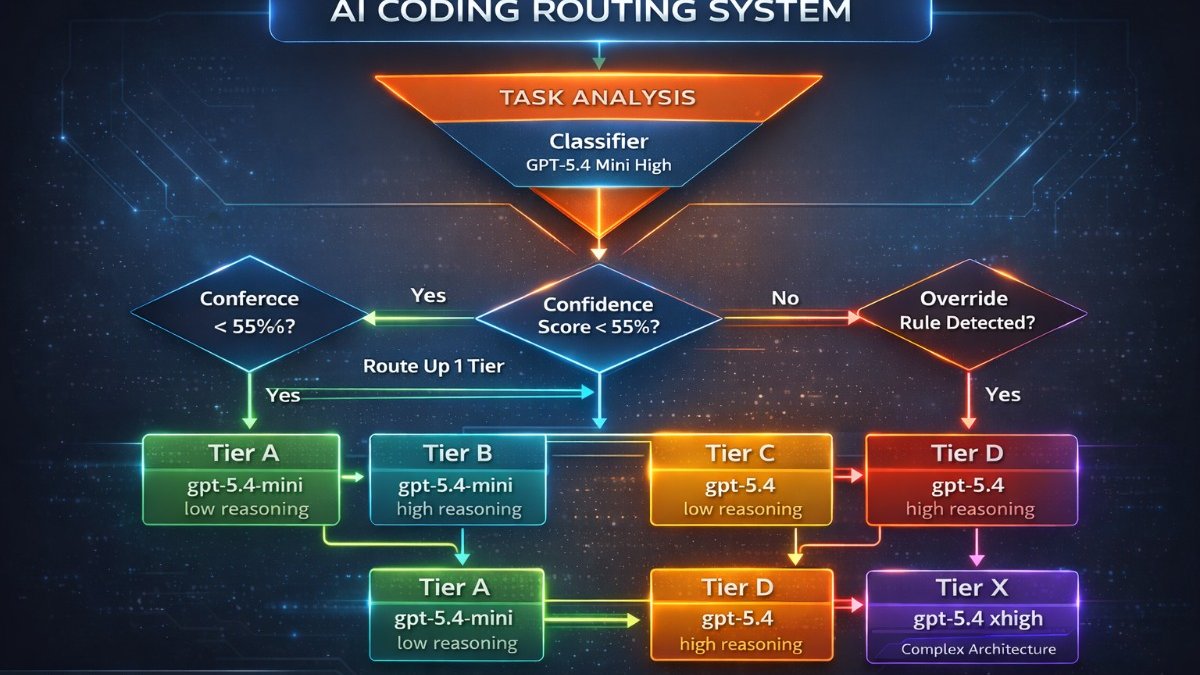
The core idea: classify first, execute second
The routing system starts with a classifier. Its job is not to solve the problem, but to understand it.
Instead of asking “solve this”, the first step asks: “How complex is this task and what level of model and reasoning does it require?”
What the classifier should measure
- Difficulty: conceptual complexity
- Scope: number of files and system impact
- Risk: cost of wrong output
- Task type: edit, bugfix, setup, architecture
- Tool usage: CLI, install, multi-step execution
- Confidence: how sure the classifier is
A practical routing ladder
Tier A
Use for: small edits, renames, quick fixes
Model: GPT-5.4-mini, low reasoning
Tier B
Use for: CRUD, validation, standard features
Model: GPT-5.4-mini, high reasoning
Tier C
Use for: multi-file changes, debugging
Model: GPT-5.4, low reasoning
Tier D
Use for: architecture, complex refactoring
Model: GPT-5.4, high reasoning
Tier X
Use for: full project generation, CMS, framework setup
Model: GPT-5.4, xhigh reasoning
Why “always use max reasoning” is not optimal
Using maximum reasoning for every task does not automatically give better results. It often wastes resources on problems that were already simple.
A rename, a small controller fix, or a template update does not need deep reasoning. Sending those tasks to the most expensive path reduces efficiency without improving quality.
Examples
Example 1: Small rename
Rename a controller and update imports.
Route: Tier A
Example 2: Feature
Add CRUD with validation and views.
Route: Tier B
Example 3: Debugging
Users get logged out after deployment.
Route: Tier C or D
Example 4: Full CMS
Install Laravel and build complete CMS.
Route: Tier X
Override rules
Some keywords should automatically escalate the task:
- install framework
- generate full project
- architecture
- root cause
- refactor system-wide
- production bug
Why this approach works
Routing is not only about saving quota. It is about applying engineering discipline to AI.
Instead of treating every task equally, you evaluate, classify, and then execute with intention. This improves speed, reduces cost, and increases reliability.
Final thought
The smartest way to use the most powerful coding models is not to overuse them. It is to deploy them precisely, where they create the most value.



